Tuesday, 26 October 2010

Seminar meeting


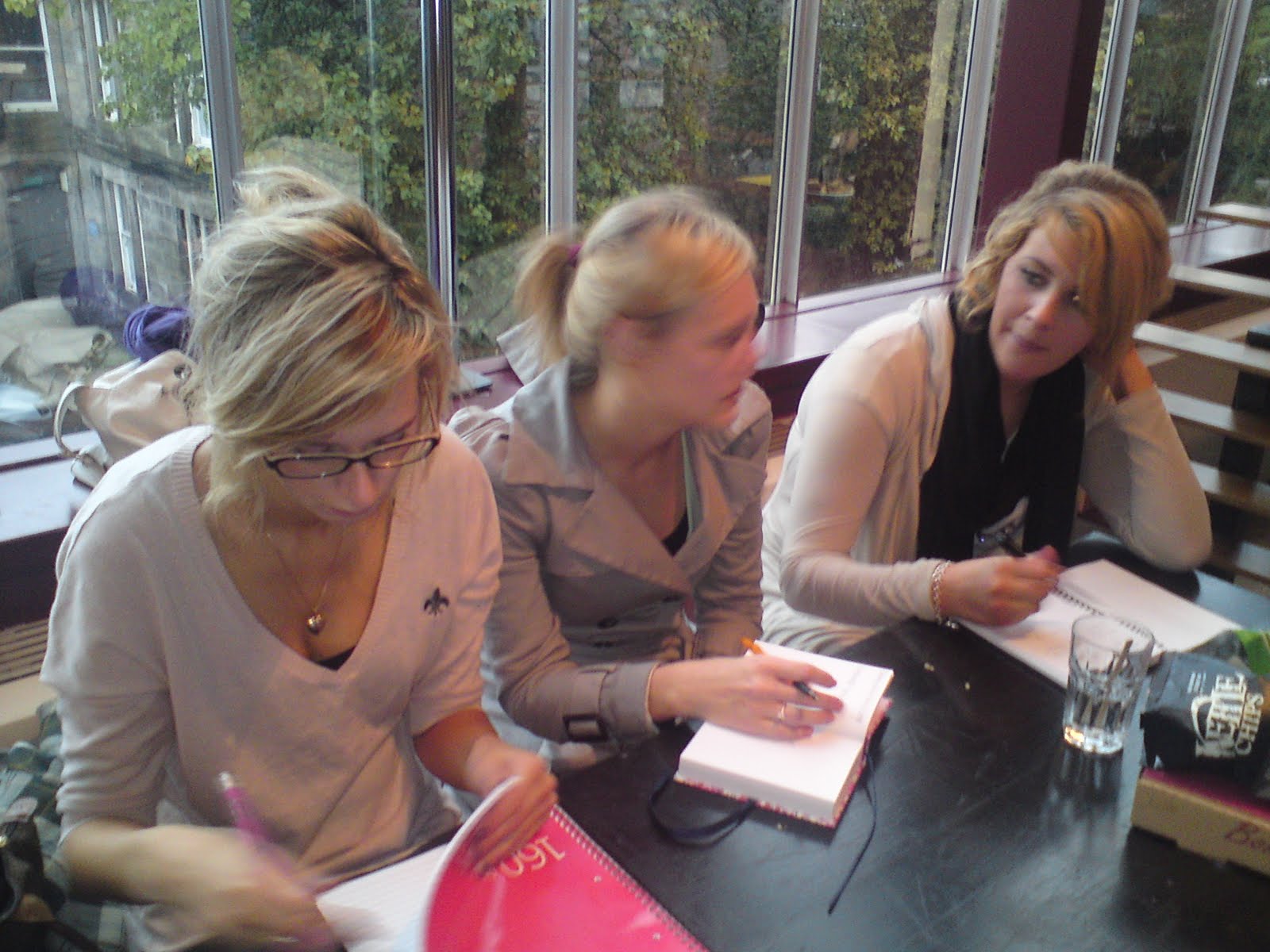
Lately it's been a little tricky trying to get our group rounded up for these meetings. Am beginning to wonder what the point to this is. Anyway yesterday a grand total of 2 of us turned up to discuss dissertation topics. To be honest I think both of us are still kinda confused as to what to base it on. I'm kinda hoping the dissertation workshop we're having tomorrow is going to clear this up and give me lots of ideas.
So far I'm kinda thinking along the lines of how people perceive things. This is mainly due to the narrative project I've just completed, which I based on how everyone's perception is different, and also the wikipedia entry I had to write on consumer culture. But who knows after tomorrow I may have changed my mind again. I guess I'll just have to wait and see :)

Tuesday, 19 October 2010

Narrative Project


Here's a few pictures of the piece I made for my 1st project in 3rd year. Really enjoyed this project. We had to design and make a narrative brooch or a scene. I chose to make a brooch and based it on how everyone perceives things differently.

Monday, 4 October 2010

Design Futures & Professional Practice Assignment 1 Wiki Entry

Here's a copy of the wiki entry I wrote on Consumer Culture and Design.


What is consumer culture?


Consumer culture is the term used to characterise a society/ culture that defines itself by the products/ goods they buy/consume. Through television, media, advertising, brand loyalty, celebrity endorsements etc, consumers are seduced by clever marketing ploys to make them think they need or want a product even if this is not really the case.


Consumer culture is all around us whether we realise it or not. It is a global phenomenon. However it is more wide spread in western societies possibly due to the fact that it originated in the west. For many people it is a way of life and part of their identity without them even knowing it. Every day as consumers we are bombarded with images and messages all trying to convince us we need a certain product, that our lives would be so much better if we bought it. You only have to turn on the TV, open a magazine or newspaper and you’ll find such evidence of this. According to (Slater, D, 1997) consumer culture is ever growing and regenerating, thus continuously grabbing the attention of would be consumers.


Brief history of Consumer Culture


There are conflicting opinions as to when consumer culture first began. Some historians believe its beginnings were in the 18th century. Around this time people were starting to take more notice of style. A marked rise in this followed which in turn saw a rise in textile manufacturing and technologies to feed these business opportunities for money and style always go hand in hand.


Other historians believe it to have originated in France in the late 19th century. During this period French retailers started using marketing and advertising to boost their sales which in turn is believed to have been the first beginnings of the department store.


However it wasn’t until the years after the second world war that consumer culture was really underway in a big way. According to (Miles, S, 1998) this is when mass marketing began. It saw the rise in people’s wages which meant more disposable income which allowed people to think about indulging themselves in ways they could not have imagined before and in no time so they were into serious consuming. Miles also refers to Henry Ford and the term ‘Fordism’. This was the name given to the late Henry Ford’s philosophy on the mass-production system that he pioneered. He believed the key to success in business was mass production, which kept costs down, and because the costs of the manufacturing were less then wages were higher which as already mentioned allowed for more expendable income and more personal indulgence and more consuming.


Psychologist Dr Edward Bernays, nephew of Dr Sigmund Freud is considered to be one of the originators of the consumer culture we know today. He was a master at public relations. Bernays himself (Bernays, E, 1928) believed it was possible to control people’s ways of thinking and perception, to a certain degree, in order to make them consume more without them even realising it. Stating that propaganda in recent years proves this theory. He called this method of manipulation ‘Engineering of consent’ . Bernays also believed that this was an important part of a democratic society and by controlling the way people think he believed that society in general would run more smoothly and without conflicts.

An example of Bernays’ ability to manipulate the masses was when in the 1920’s when the American tobacco company came to him for help in trying to persuade women into take up smoking. In the BBC documentary (The Century of the self, May 2002) You see how Bernays orchestrated a media frenzy by sending a group of women to the New York city parade instructing them to light up their cigarettes on his signal. He of course alerted the media stating that a group of women’s rights activists were planning a protest ‘Lighting torches of freedom’. The media were there to catch the story and it became front headline news thus practically eradicating the taboo subject of women smoking.


Today Bernays’ techniques are still going strong. Whether we like it or not we are constantly being manipulated by marketing and advertising. How many times have you seen an advert on the television or in a magazine and thought ‘hey I’d like that’ When in truth had you not seen the advert you wouldn’t even have thought about it let alone consider buying it. So maybe next time you find yourself in this position stop a second and ask yourself ‘Do I really need this? or is it more that someone else for less than altruistic reasons thinks I need this? Being aware of marketing strategies helps us to question and even to resist but humans being human many of us still manage to be persuaded as some marketing is very subtle and cleverly presented.


Relevance of consumer culture to design practice


Without design consumer culture simply would not exist. For consumer culture to work we need things like advertising and marketing and these process have to start somewhere and that is through a design process. All the imagery we see everyday, all the slogans good and bad and mediocre have all been planned and designed. Designed in such a way as to temp you as a consumer to buy a certain product. For instance advertising. Before you can sell a product you need to have a target market in mind, somewhere to punt it in a profitable way, then there is how the item is going to be packaged/branded (again bearing in mind the target market) and how that item is going to be portrayed to this market in order close the deal of persuading, to make as many people as possible want the item enough to actually buy. The use of imagery, layout, colour choice, typography etc are all important factors and again knowing the target’s preferences etc. is vital so here comes in the market research industry to provide the right information required. If this is not well collated then the promotion of a product may miss the target or fail to grab people’s attention and ultimately the product will not sell resulting in loss of the desired profit.


Imagery plays a major part in consumer culture as it helps people to identify with the product and instantly recognise it. A prime example of this is the Nike logo which is the result of very careful market research which is built on year on year. This company understand their market and apply all their design and promotional expertise to this and they are very good at it. As soon as people see the logo they know straight away what brand it is and accept what it implies.


A major player in consumer culture and design was industrial designer Raymond Loewy. He designed everything from postage stamps and cigarette packets to cars. According to the website (http://www.raymondloewy.com/about/bio.html, 26th September 2010) some of Loewy’s most recognisable work was the coca cola bottle and the shell petrol logo which are instantly recognisable for many of us today. Through his designs Loewy managed to increase profits for many big businesses. An example of this was when the American tobacco company drafted him in to re-design the lucky stripe brand of cigarettes. Here was a designer who had a great feel for the market and as a result did he not only increased sales of this particular brand of cigarettes with the new packaging he also saved the company money as he changed the packaging form green to white therefore cutting out the cost of the green dye.


Imagery is so important and we as consumers may not realise it but when we see an object for the first time we make so many assumption about it in a split second. So it is important for designers to get this right and this only happens with market knowledge and understanding of possible mass reaction. The documentary (Objectified 2009) looks at this concept, how some of the world’s most influential designers come up with these ideas and how we as consumers react or interact with the objects around us. This documentary also looks at how designers are constantly coming up with new and innovative ways to keep us buying products and ultimately keeping consumer culture alive.


Of course we must also accept the importance of the resulting flow of money to steady growth in any developing society.


Bibliography


Bernays, E, 1928. Propaganda. New York: Horace Liverigh

BBC4, Curtis,A, 2002, The Century of the self, Documentary

Hustwit, G, 2009, Objectified, Documentary film

Miles, S, 1998. Consumerism as a way of life. London: Sage publications

Origin 68 T-shirt. Buy lots of things make life better you can have it all consume. May all your dreams come true but don’t forget Image available at www.teritic.com

Raymond Loewy The father of industrial (online) available at

http://www.raymondloewy.com/about/bio.html

Schor Scribner, J.B. Born to buy. Image available at www.frankwbaker.com/toybooks.htm

Slater, D, 1997. Consumer Culture & Modernity. Cambridge: Polity Press,

Sunday, 3 October 2010

Seminar meeting


This week my seminar group had another meeting. We discussed how we were getting on with our assignment and tried to give each other ideas regarding our topics. We all agreed that it would be a good idea to meet up before the assignment submission date and see how we all got on writing our wikipedia entries. That way if anyone has any queries or questions about the wiki entry we could hopefully give each other ideas.

Sunday, 19 September 2010

Design Futures & Professional Practice Assignment 1


So third year has already started and I'm getting stuck into my new assignments. This years Design Studies or should I say Design Futures & Professional Practice, seeing as the name has changed, consists of working collaboratively with people from other disciplines within the art school. Could be interesting. Kinda nice to meet other people out with my discipline seeing as I was a direct entry student and don't know many people from other departments.

During our first lecture we were put into seminar groups of about 8. This year these groups seem to be self motivated unlike last year where we actually had a seminar teacher.

So for our first assignment we had to meet up as a group and all pick a different topic from the list given in the previous lecture. We have to then develop our chosen topic into a research report which will eventually be uploaded as a Wikipedia entry on the uni website.

The topic I have chosen is consumer culture and design. Mainly because I found the lecture we had on this pretty interesting. Also it ties up with my current jewellery project as I am looking at how different people perceive and react to things. I've included a photo of the mind map I made on this subject.

The other topics chosen within my group were Branding & design, Climate change & design, Crime & design, Social change & design. We then brain stormed each topic giving each other ideas which hopefully will come in useful when writing our reports.

Thursday, 15 April 2010


Here are a few rings I made recently as part of my stone setting module. Using different methods of stone setting. Both rings are silver, one is set in a claw setting with a citrine and the other is set with an amethyst in a flush setting.

Sunday, 28 March 2010

Design Studeis Assignment 5 Essays

During last semester’s design studies our assignments focused on secondary research methods whereas this semester focused on primary. For our final assignment for this semester we were asked to look back on what we learned in the 1st semester paying particular attention to the essay we wrote and applying the primary research skills we learned from this semester to see if there was anything that we could have done differently to improve on the research already carried out.

My essay last year was based on biometric systems and how they are used to combat i.d. fraud. I looked at both sides of the argument and read various journals and books on biometric systems and i.d. fraud.(Cohn L jul 2009, Jain A K, Pankanti S Sep 2008, Lyon D 2009, Wagner P Apr-June 99)

To be honest the more I read up on the subject the more I realised how serious a problem i.d fraud really is. Not that I wasn’t already aware that i.d. fraud is a major problem but I think it’s one of these things that you tend not to think about very often or maybe we deliberately try not to think about it, or possibly we never really think that it’ll ever happen to us. Whatever way you look at it, it is a serious problem that continues to grow and although technology is advancing at a rapid rate the people who are steeling people’s identities and committing i.d fraud only seem to be a step behind.

Whilst doing research for this essay I found some of the proposed biometric systems that could come into everyday life in the future quite scary and in my opinion somewhat an invasion of personal privacy. I know these systems are supposed to be in place to protect us but the thought of a database holding a massive amount of information on everyone is for me disconcerting and also poses the question who exactly and how would this database be regulated, who would do it, and very importantly who would be in control? This brings on the further question of who would have access to it, why would they have access and what would they do with the information once they had it?

Kind of makes you wonder what ever happened to anonymity?

It would be interesting to see what other people think about this, whether they have similar concerns over these particular biometric systems as I do or whether they think that they would be a good thing and why?

So by using the primary research methods I learnt this semester how would I improve on the research I did for last semester’s essay? Well, first of all I think I would go out and interview people after carefully considering the questions I might ask and how to put the questions as it would be pointless to appear subjective on the matter. The answers given would hopefully indicate their opinion on this subject without me steering them towards a reply. This may even allow me to discover whether or not they are actually aware of biometric systems, because not everyone will be. I’d also hope to hear what they think might improve this ever growing problem. I’d also ask them if they have experience of encountering biometric systems and if so does this happen on a regular basis, i.e. at work.

I think it would be really interesting to find out everyday peoples’ views on this. To see if they are actually aware of how major this problem is.

I suspect the results might be quite surprising.

It would also be a good idea to interview someone who either works with biometric systems or someone who works in some area of fraud prevention, although this might be tricky to organise as they may not be able or allowed to freely talk about their work. However if it was possibly to interview someone in this sector I would ask them questions that I raised from my previous research for example what is the future for biometric systems? Will they become more common place in our society? How or who would regulate them and how secure is the information they hold? Have they conducted their own research into how the general public feel about biometric systems? If so what kind of feedback did they receive?

I may also do an experiment like show people a list of various biometric systems and ask them which ones they think are already in use or which ones do they recognise or do they even recognise any of them. I think this would give me a better understanding of how aware people are of these technologies.

The observation skills we learned this semester would also be helpful in seeing how people react to using biometric systems. Again I think this might prove tricky to achieve as most biometric systems are used in places where you really need to be authorized to be there i.e airports, government offices or maybe science labs. So possibly a combination of the secondary research I did last semester, looking at various books and journals, and the interview methods I learnt this semester would on the whole provide a more productive outcome even although it is not primary in nature.

Out of the different research methods we explored this semester I definitely think that for this particular topic (biometric systems/i.d. fraud) interviewing people would be the best way of gaining more insight into how the general public feel about this topic and also what they know. It would require careful consideration before the interviews took place and careful handling during the interviews.

I may also conduct a poll (this would again necessitate very careful compilation and fairly large numbers to have a meaningful result) to see how many people have actually experienced i.d. fraud, whether it be stolen bank details, passports or national insurance numbers etc and ask them how they dealt with the situation. Was it rectified, was it rectified quickly, how, if at all it affected them on a personal level and what measures they take now to insure that it doesn’t happen again. I would also need to conduct this poll in a variety of different areas to see if there were any places where this problem is particularly prominent or even where there is little or no problem.

It would also allow me to see if there is any particular type of i.d. fraud that stands out more than the others and by asking a variety of different age groups this would allow me to see if there is a particular age group that is targeted more than others. I might also try and interview an equal amount of men and women just to see if more women than men or visa versa have experienced i.d. fraud in some shape or form.


Bibliography
Cohn, L (jul 2009), What you need to know about identity theft, Kiplinger’s personal finance, Business source premier Jain A K, Pankanti, S (Sep 2008)
Beyond Fingerprinting, Scientific American, Business Source PremierLyon D,(2009),
Identifying Citizens i.d cards as surveillance, Polity PressWagner, P (Apr-June 99) Technology for anonymity: Names by other nyms, Information society, Taylor and Francis


Studio Brief essay


For the second part of my design studies essay I was asked to choose a studio brief I tackled this year. Then by applying the primary and secondary research methods I learnt this year during my design studies module discuss how would I utilise these techniques during the research and design process if I was to do this brief again?

So far our studio briefs have been quite diverse. We started off with the vessel project where we had to design and make some kind of vessel for holding things. It could be absolutely anything and was left up to your interpretation as long as it was a vessel. I made a small copper teapot, or should I say treepot, based on the trunk of a tree with the feet of the teapot being the roots. The second brief was the wire project where we had to design and make an item of jewellery incorporating wire in an interesting way. For this project I designed and made two brooches taking design inspiration from Miro paintings as his paintings are full of bold shapes and more importantly are very linear.

The third studio brief was the catwalk project where we were asked to design and make a flamboyant colourful piece, based on a culture or period of time. It’s main reason for being was to be effective on a catwalk as a fashion statement. I decided to make a headpiece and based it on African culture. I chose African culture because of the bright colours they use and because they adorn their bodies in interesting ways. The project we are working on at the moment is stone setting. We had to design and make an item based around symbolism and incorporate an unusual and interesting stone setting into the design. Out of all the projects I’ve found this the most interesting, maybe because stone setting is an art form in itself and most times can be very tricky, requiring much care, taking a great amount of time and much patience.

To be honest I already apply secondary research skills to my briefs. If I take the stone setting brief for instance I started off researching in the library and then online looking at the different qualities of gemstones. I then went on to look at gemstone hardness, how they are formed, different types of cuts and settings. If I was to apply primary research at this stage I think I would have interviewed a stone setter to get more insight into the various different ways of setting stones. This would also have helped me to decide which stone setting or possibly stone would be most suited to my final design.

I then moved on to researching different symbolism through the ages and the ways gemstones and jewellery have been used. I focused my research on ring symbolism looking at various and different types of rings through the ages. This again involved using secondary research looking at a wide range of books and websites. I then moved on to looking more closely at wedding rings, paying particular attention to Jewish betrothal rings, how they came about, their role in ceremonies and how they have been used over the decades. Again I used secondary research at this stage in the form of a mind map to help generate ideas of what marriage might signify to the people involved. Possibly I could have also at this stage conducted interviews to see what marriage actually means to people.

The primary research methods could also have came into play after coming up with a few design ideas. By showing a number of people these ideas and asking them to choose the one which they find the most attractive or the most appropriate for this particular brief.

I think the primary and secondary research methods I learnt in design studies this year would actually be more use when it comes to designing for the public rather than researching a brief. Here it would be imperative to use various primary and secondary research techniques.

For example if a client commissions me to make an item of jewellery I would start off by asking them what exactly they are looking for i.e is it a ring, a bracelet, pendant etc. Then I would asked them what they are in to with careful questioning to try and gain more insight into what design ideas I might come up with which might hit the spot and gain real approval.

Sometimes when designing for people it can be hard to get to the bottom of what they are really like just by asking them questions. Depending on the person people can sometimes seem almost like a closed book so I think this is where the observational skills come into play. For example I would observe their body language, dress sense and their reaction to certain questions I ask. All of these would help me gather a better picture of what they might really be looking for. I would also show them examples of my previous work and gauge their reactions to the pictures I show them. Paying particular attention to the items of jewellery that they find the most attractive and asking them what is it about these items that they like.

Personally I already think I use these techniques in my research process to help me with the design process although possibly before now I wasn’t completely aware that I was doing this. It had just sort of developed and I found it worked for me. So I think the one thing this semester has done for me is that it’s made me more aware of these techniques and how I use them within my discipline and I also feel a sense of pleasure that intuitively I was already sensing the need to do all this to achieve a satisfactory client outcome.